
Search behavior is changing fast. People are no longer just typing short phrases into Google. They’re speaking full questions, snapping photos, and expecting instant, accurate answers.
For small businesses, this shift creates a real opportunity. Whether you run a jewelry store, a plumbing company, or a roofing business, showing up in these new types of searches can bring in more qualified leads without increasing your ad spend.
Let’s break down what multimodal and voice search mean and how your business can take advantage of both.
Table of Contents
ToggleWhat Is Multimodal Search?
Multimodal search allows users to combine text, images, and voice to find what they need.
A customer might:
- Take a picture of a ring and ask where to buy something similar
- Snap a photo of a leaking pipe and search for a fix
- Upload an image of roof damage and look for repair services nearby
Search engines like Google now process all of this together, not separately.
For small businesses, that means your content needs to go beyond basic text. Images, videos, and well-structured information all play a role in whether you show up.

What Is Voice Search?
Voice search is exactly what it sounds like. People are talking to their phones, smart speakers, and vehicles to get answers.
Instead of typing:
“plumber Dallas”
They’ll say:
“Who’s the best plumber near me that can come out today?”
These searches are longer, more conversational, and often tied to immediate intent.
That last part matters. Voice searches often lead to quick decisions and fast conversions.

1. The Proximity Power-Play
While a national retailer might spend millions on broad SEO, they struggle to capture the nuance of a specific neighborhood. Multimodal and voice searches are inherently “on-the-go” queries.
The “Near Me” Logic: When someone asks their glasses or phone, “Where can I get a watch battery replaced nearby?” the AI isn’t looking for the most famous brand; it’s looking for the most reliable local solution.
The Trust Factor: Small businesses often have deeper roots. A high density of local reviews and a history of check-ins tells search engines that you aren’t just a business—you’re a community staple.
2. Winning the “Show and Tell” (Multimodal Search)
Multimodal search (using a mix of images, text, and video) allows users to search with their camera. For a small business, this is a game-changer.
Visual Search: Imagine a customer sees a unique bouquet of flowers or a specific style of patio furniture. They snap a photo and ask, “Who sells this in [City Name]?”
The Small Biz Edge: If your website and Google Business Profile feature high-quality, tagged images of your specific inventory, you become the direct answer. Large brands often use stock photos or generic catalogs; your authentic, local photos are what the AI uses to bridge the gap between a user’s photo and your storefront.
3. Conversational Clarity (Voice Search)
People talk to Siri, Alexa, and Gemini differently than they type into a search bar. They use long-tail questions: “What’s a good coffee shop nearby that has gluten-free muffins and free Wi-Fi?”
Accuracy over Authority: In voice search, there is often only one result provided (the “Position Zero”).
Clarity is King: Big brands often have bloated, complex websites. A small business with a clean, FAQ-style “Services” page that answers specific local questions can leapfrog a massive corporation because its information is easier for an AI to parse and read aloud.
4. The “Digital Presence” Checklist
To win these searches, a small business doesn’t need a bigger budget; it needs a sharper presence. This involves:
Structured Data (Schema): Telling the “bots” exactly what your hours, prices, and locations are in a language they understand.
Hyper-Local Content: Writing about the neighborhood events you sponsor or the specific local problems you solve.
Review Velocity: Encouraging a steady stream of recent, keyword-rich reviews (e.g., “Best vegan tacos in East Austin”).

1. Use High-Quality Images That Reflect Real Work
Stock photos don’t cut it anymore.
Use real images of:
- Completed roofing jobs
- Plumbing repairs in progress
- Jewelry pieces in your store
Name your image files clearly and add descriptive alt text. Think like a customer. What would they search if they were looking at that image?
2. Add Context to Every Image
Don’t just upload photos and move on.
Include:
- Captions that explain what’s shown
- Location details when relevant
- Service descriptions tied to the image
A photo of a diamond ring should include details about the cut, style, and availability. A roof repair photo should mention the type of damage and the solution.
3. Create Content That Answers Real Questions
Multimodal search often connects images with questions.
Examples:
- “What type of roof damage is this?”
- “Is this ring style considered vintage?”
- “Why is this pipe leaking at the joint?”
Build pages or blog posts that answer these types of questions clearly and directly.

1. Write Like People Talk
Voice searches sound like conversations.
Use natural language in your content:
- “How much does it cost to fix a leaking pipe?”
- “What’s the best metal for an engagement ring?”
- “How long does a roof replacement take?”
These are the exact phrases your customers are speaking into their devices.
2. Focus on Local Intent
Voice searches often include location, even when it’s not spoken.
Make sure your business information is consistent across:
- Google Business Profile
- Your website
- Online directories
Include your city and service area throughout your content in a natural way.
3. Build FAQ Sections That Actually Help
FAQ pages are perfect for voice search.
Keep answers:
- Clear
- Direct
- Easy to scan
Short, helpful responses increase your chances of being pulled into featured results and voice responses.
4. Improve Site Speed and Mobile Experience
Most voice searches happen on mobile devices.
If your site is slow or hard to navigate, users leave. Search engines notice that.
Make sure your site:
- Loads quickly
- Looks clean on mobile
- Makes it easy to call or contact you
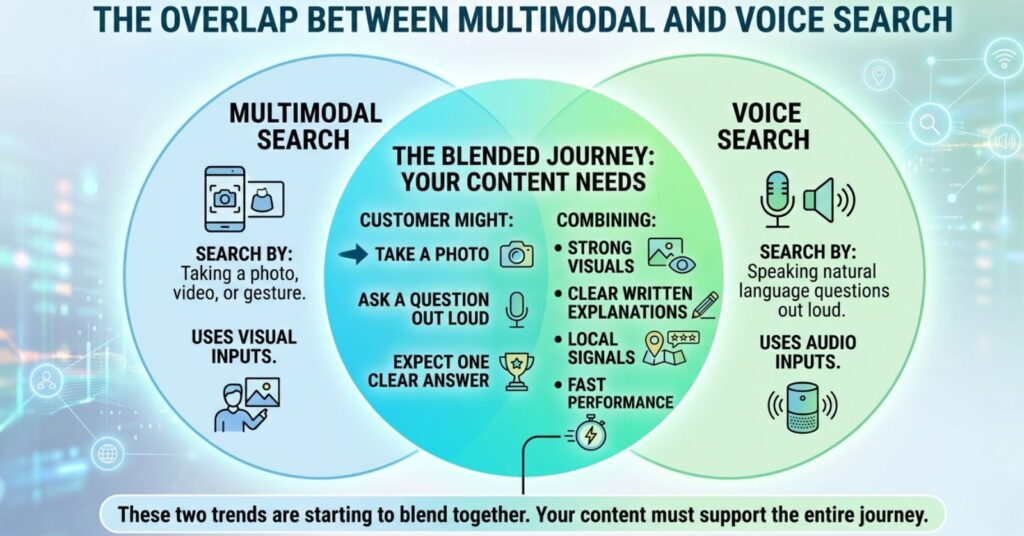
As the diagram illustrates, multimodal and voice search are not two separate, parallel trends—they are converging. The central overlap reveals that a customer’s search journey now routinely blends visual, audio, and textural inputs into a single, cohesive experience. When someone sees an item and speaks a question about it, they don’t want a fragmented response; they expect a single, unified, and hyper-relevant “best answer.” For a small business, winning in this landscape means moving beyond siloed strategies and creating a seamless “digital storefront” that combines strong visuals, clear written service pages, and local structured data to provide that perfect, trusted answer.

- You don’t need to outspend competitors. You need to be more relevant.
- If your content reflects real work, answers real questions, and makes it easy for customers to take action, you’re in a strong position.
- Most small businesses haven’t adapted to this shift yet. That gives you a head start.
Conclusion
Search is moving toward convenience. People want fast answers, accurate information, and businesses they can trust right away.
Multimodal and voice search both reward clarity, consistency, and real-world relevance.
If your website and content reflect how your customers actually search, you’ll show up more often, attract better leads, and turn more of them into paying customers.