If your website was a salesperson, would you keep them on staff?
It might sound harsh, but it is a fair question. A lot of small businesses are doing the right things to get attention online. They are posting on social media, showing up on Google, maybe even running ads. The traffic is there. People are visiting the site.
But then nothing happens.
No calls. No form fills. No real leads.
That gap between traffic and conversions is where most businesses get stuck. The good news is that the problem usually is not complicated, and it does not take a full redesign to fix it. In many cases, you can make meaningful improvements in less than an hour.
Let’s walk through a few of the most common issues and how to clean them up quickly.
Table of Contents
ToggleYour Homepage Is Not Clear Enough
When someone lands on your website, they are trying to answer a simple question. “Am I in the right place?”
If your homepage is vague, cluttered, or trying to say too much at once, visitors will leave before they figure it out.
A strong homepage should quickly explain what you do, who you help, and what the visitor should do next. This needs to happen without scrolling.
Take a look at your top section. If it reads like a general mission statement or a list of services, it is probably not doing its job.
A better approach is to lead with something direct and specific. Think in terms of outcomes. Instead of listing services, focus on how you help solve a problem.
Then pair that message with a clear next step. That could be booking a call, requesting a quote, or checking availability.
Clarity always beats creativity here.

Your Call To Action Is Too Weak
Even if your messaging is solid, your website still needs to guide people toward action. That is where a lot of businesses fall short.
Buttons like “Learn More” or “Click Here” do not give people a strong reason to take the next step. They feel passive and easy to ignore.
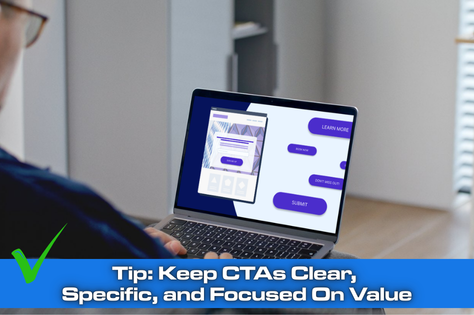
A good call to action should feel like a natural continuation of the visitor’s intent. It should be clear, specific, and focused on value.
Something like “Get a Free Quote” or “Schedule Your Consultation” sets expectations and gives the user a reason to engage.
It is also important to make sure those calls to action are easy to find. They should appear early on the page and be repeated throughout, especially after key sections.
If someone has to hunt for the next step, they are not going to take it.
You Are Asking for Too Much Too Soon
Forms are one of the biggest drop off points on any website.
It is understandable why businesses want to collect as much information as possible. The problem is that from the user’s perspective, a long form feels like work.
If someone is just getting to know your business, they are not ready to fill out ten fields and write a detailed message.
Simplifying your forms can have an immediate impact on conversions. Start with the basics. Name, contact information, and one simple question to qualify the lead is often enough.
Once that initial connection is made, you can gather more details later in the process.
Lowering the barrier to entry makes it easier for people to say yes.
Your Website Is Too Slow
Speed matters more than most people realize.
If your site takes too long to load, visitors will leave before they even see your content. This is especially true on mobile, where attention spans are even shorter.
A slow site can also hurt your visibility on search engines, which means it impacts both traffic and conversions.
The fix does not have to be complicated. Large image files are one of the most common issues. Compressing images and removing unnecessary plugins can make a noticeable difference.
It is worth testing your site on your phone using cellular data. That experience is often very different from what you see on a desktop.

There Is No Real Proof You Are Legit
Trust is everything online.
If a potential customer lands on your site and does not see any proof that you are credible, they are going to hesitate. In most cases, they will leave and keep searching.
This is where trust signals come in. Reviews, testimonials, real photos, and even simple details like how long you have been in business all help build confidence.
If your website feels generic or stock, it creates doubt. People want to see real work, real results, and real customers.
Adding a handful of strong reviews and a few authentic photos can go a long way toward making your business feel more established and trustworthy.
Try the 30 Minute Website Fix
If this all feels like a lot, it does not have to be.
Set a timer for 30 minutes and focus on a few high-impact changes.
Update your homepage headline so it clearly explains what you do and who you help. Replace a weak call to action with something more direct and benefit driven. Add at least one real customer review to your site. Take a look at your main contact form and remove anything that is not essential.
These small adjustments can create a noticeably better experience for your visitors, and that often leads to more conversions.
Where Media Caffeine Comes In
Most small business owners know their website could be working harder for them. The challenge is finding the time and knowing what to fix first.
That is exactly where Media Caffeine can help.
We work with small businesses every day to turn underperforming websites into lead-generating tools. From SEO that brings in the right traffic, to social media that builds awareness, to websites that are built to convert, our focus is always on helping you get real results.
If your website is getting attention but not producing leads, it is not something you have to figure out on your own. Our team is here to help you make sense of what is happening and build a strategy that actually moves your business forward.
When your digital marketing is working together the right way, your website stops being a problem and starts becoming one of your most valuable assets.